Store
| System | Format | Link | Verification |
|---|---|---|---|
 Linux | appimage ARM64 |  | |
Linux | appimage X86_64 | | |
 macOS | dmg X86_64 | | |
 Windows | exe I686 | | |
Windows | exe X86_64 | |
OpenSCAD
Overview
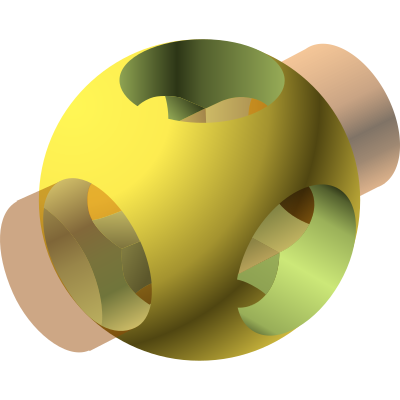
OpenSCAD is a free, open-source scripting-based 3D modeling software. Unlike traditional mouse-driven modeling tools, it defines geometries through code (scripting language), generating parametric, version-controlled 3D models. OpenSCAD emphasizes "programmer-friendliness" and "precise control," making it suitable for mechanical engineering, product design, 3D printing prototyping, and educational settings. Created by Clifford Wolf and Marius Kintel, it is hosted at openscad.org and GitHub, licensed under GPL v2, and supports Windows, macOS, and Linux platforms.
History and Development
- Origins:
- 2009: Clifford Wolf began developing OpenSCAD as an implementation of the SCAD language, aiming to create "CAD for programmers."
- 2010: Marius Kintel joined, and the project was officially open-sourced.
- Key Milestones:
- 2011: Release of version 2011.12, supporting basic CSG (Constructive Solid Geometry).
- 2015: Introduction of lazy union and fast-CSG preview acceleration.
- 2019: Support for manifold rendering (more accurate Boolean operations).
- January 2021: Release of the 2021.01 stable version, with optimized GUI and export features.
- 2023-2025: Development versions continue to be updated, supporting the Roof module, textmetrics(), and experimental Vulkan rendering.
- Community and Support:
- Maintained by a global community of developers, with documentation including a user manual, CheatSheet, and YouTube tutorials.
- Highly active in 2025, suitable for the 3D printing community.
Main Features
- Scripting-based Modeling:
- Uses the OpenSCAD language (similar to C), constructing models through CSG operations such as union(), difference(), and intersection().
- Parametric Design:
- Supports variables, modules (functions), loops, and conditional statements; modifying parameters automatically updates the model.
- Applications: Custom 3D printed parts.
- Preview and Rendering:
- F5 for fast preview (fast-CSG), F6 for high-quality rendering (manifold).
- Application: Real-time debugging of complex models.
- Export Formats:
- STL (3D printing), OFF, AMF, DXF, SVG, PNG.
- Application: Export to FreeCAD or Cura slicer.
- Cross-Platform Compatibility:
- Windows/macOS/Linux, AppImage/Flatpak support.
- Hardware Compatibility:
- Minimum: 1 GHz CPU, 512 MB RAM.
Advantages and Limitations
Advantages:
- Code-driven: Models are pure text, allowing for Git version control and highly parametric design.
- Completely free and open-source: GPL v2, no restrictions.
- Precise control: Accurate geometric operations, suitable for engineering/3D printing.
- Lightweight and fast: Starts in <5 seconds.
- Community support: Abundant tutorials, few plugins but a stable core.
Limitations:
- Non-interactive: No mouse-based drag-and-drop modeling, steep learning curve.
- Basic GUI: No advanced rendering (requires Blender for this).
- Slow updates: Stable version stuck at 2021.01, relies on development snapshots.
- Comparison with other software:
- FreeCAD: Interactive + parametric.
- Blender: Strong artistic rendering.
- Tinkercad: Drag-and-drop for beginners.
- Fusion 360: Cloud collaboration, paid.
Summary
OpenSCAD is a free and open-source scripting-based 3D modeling software, based on CSG and parametric code, suitable for precise engineering, 3D printing, and version-controlled models. Compared to FreeCAD (interactive), Blender (rendering), Tinkercad (beginner), and Fusion 360 (paid), OpenSCAD stands out for its code-driven approach and precision, but lacks mouse-based modeling and has slow updates. It is ideal for programmers and parametric design enthusiasts, and integrates perfectly with FreeCAD.
 FreeCAD
 LibreCAD
 KiCad
KiCad
 LibrePCB